‘Critical Essays’ category
Explore a curated selection of working papers that offer critical, reflective, and analytical engagements with Pacific worlds. These essays foreground Pacific knowledge, lived experience, and scholarly critique, examining social, cultural, political, spatial, and creative issues shaping Pacific communities. Written to be accessible to both researchers and our communities, the papers invite dialogue and thoughtful feedback that centres and strengthens Pacific knowledge.
Critical Essays — PARC Working Paper Series
The Critical Essays category of the Pacific Australia Research Centre (PARC) Working Paper Series provides a dedicated platform for Pacific pracademics, community researchers, early‑career scholars, and established academics to share critical, reflective, and analytical work that contributes to Pacific‑led knowledge creation. This category supports the circulation of developing arguments, conceptual and theoretical explorations, comparative analyses, and critical reflections that interrogate issues shaping Pacific lives, places, and futures.
Working papers in this category prioritise Pacific perspectives on health, wellbeing, migration, education, Indigenous and Pacific methodologies, material and spatial cultures, and community‑led research. Authors are encouraged to contribute essays that centre Pacific sense‑making, strengthen Pacific voices, and advance culturally grounded critique in support of collective and intergenerational wellbeing across Australia, Aotearoa New Zealand, and the wider Pacific region.
Critical Papers
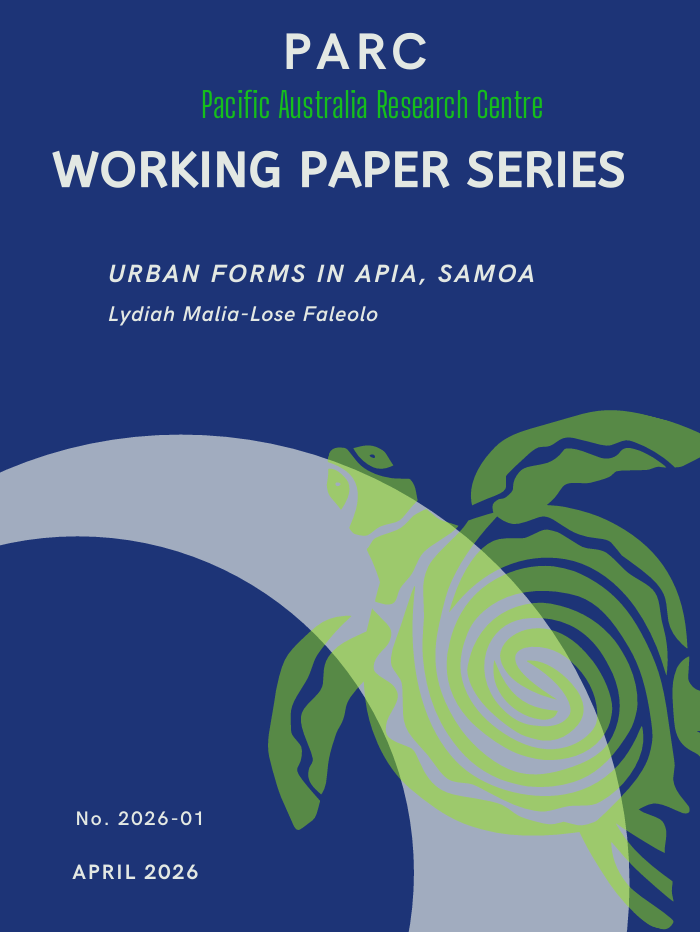
Urban Forms in Apia, Samoa
Lydiah Malia-Lose Faleolo
This essay explores how the city of Apia in Samoa has developed over time, shaped by its history, culture, and environment. It compares two different areas: the busy central city (CBD) and the quieter village of Avele. The CBD is dense and active, with shops, offices, and roads close together. Its buildings reflect a mix of colonial history and modern development, supporting trade, government, and a growing population. However, this growth also brings challenges such as overcrowding, pressure on infrastructure, and increased vulnerability to environmental risks.
In contrast, Avele follows a more traditional way of living, with a low-density layout focused on community and shared spaces. Homes are centred around the fale, a traditional Samoan structure used for everyday and cultural activities. The village prioritises strong social connections rather than commercial development, and while it has less access to modern infrastructure, it maintains cultural identity and resilience. By comparing these two areas, the essay highlights how Apia is balancing modern growth with tradition, suggesting that future development should protect cultural values while supporting sustainable and resilient urban change.
Faleolo, L. M. L. (2026). ‘Urban forms in Apia, Samoa.’ Pacific Australia Research Centre Working Paper Series, 2026-01. PARC, Australia. DOI: 10.13140/RG.2.2.12212.00648
https://www.researchgate.net/publication/403529364_URBAN_FORMS_IN_APIA_SAMOA