‘Creative Expression’ category
Take a look at our working papers, curated with care and designed to share Pacific meaning making and sense making. Each one demonstrates the wealth of Pacific knowledge that exists not only on Pacific matters but on global topics using a Pacific lens.
Creative Expression
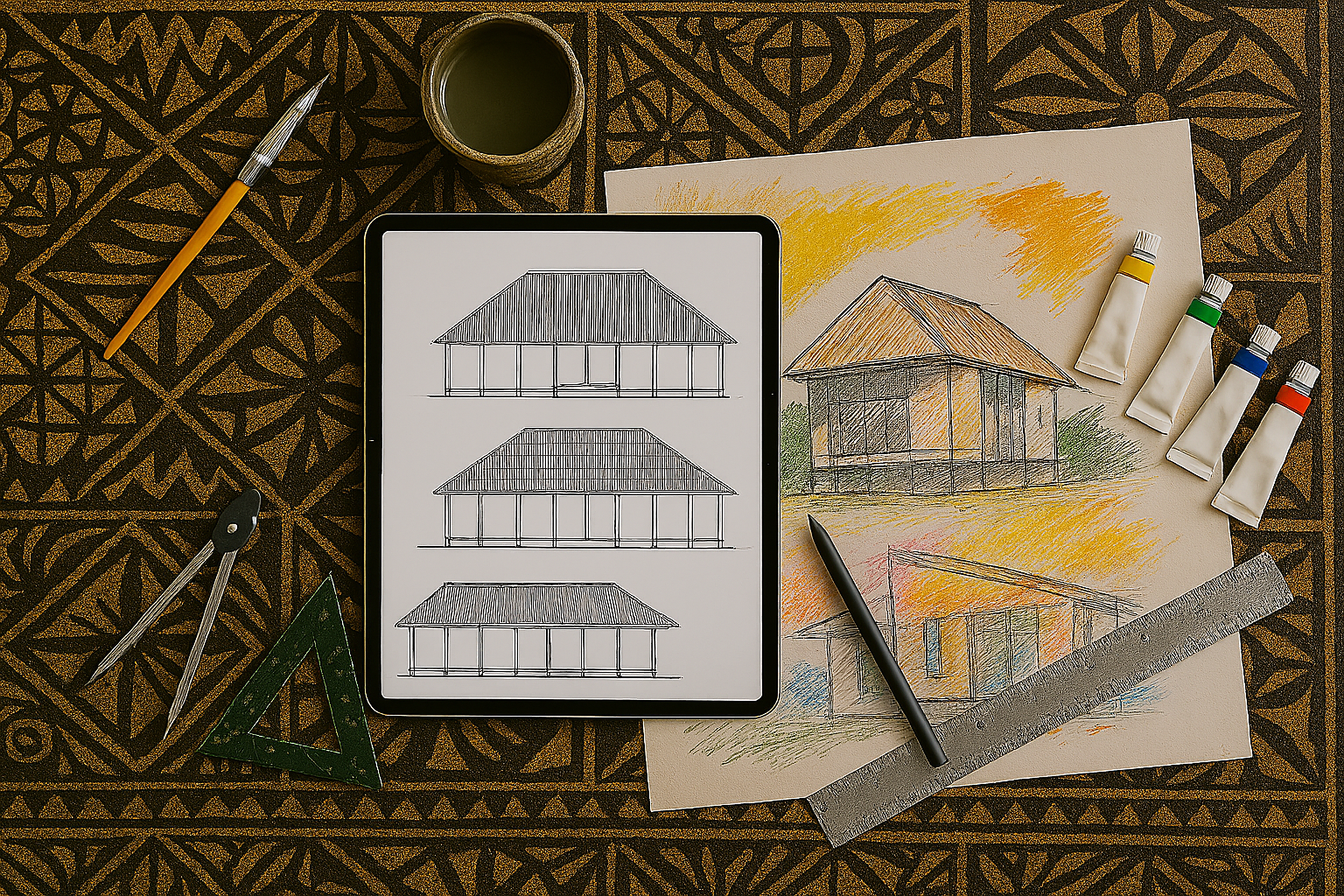
The Creative Expression category foregrounds Pacific creativity as a vital mode of knowledge production, research, and cultural continuity. Showcasing work across visual arts, performance, design, storytelling, architecture, and other creative practices, this space recognises creative expression as a living methodology grounded in Pacific worlds.
Contributions in this category explore how Pacific peoples think, theorise, remember, and imagine through creative forms. These works may sit alongside, extend, or challenge conventional academic outputs, offering insight into Indigenous ways of knowing, being, and relating. Creative Expression at PARC affirms creativity as research practice—relational, embodied, intergenerational, and deeply connected to place.
Creative Working Papers
Moana Tulai
Lydiah Malia-Lose Faleolo
This project, Moana Tulai, looks at how architecture can help Pacific Island communities who may be forced to move because of rising sea levels. As explained in , climate change is already threatening homes, cultures, and ways of life across the Pacific, with some communities expected to relocate in the future. The project explores how new housing can be designed to support these communities, especially when they move to places like Australia. It uses ideas from architect Jørn Utzon, who believed buildings should connect people, nature, and culture, to create spaces that feel meaningful and supportive rather than just functional.
At the same time, the project is strongly based on Pasifika cultural values. Traditional homes, known as fale, are designed around community, relationships, and shared living. A key idea called Tauhi Va focuses on maintaining strong social connections through space. Moana Tulai uses these ideas to design housing that supports both private living and shared community spaces, helping people feel a sense of belonging even after displacement. Overall, the project shows how architecture can go beyond shelter, helping communities stay connected to their culture while adapting to the challenges of climate change.
Faleolo, L. M. L. (2026). ‘Moana Tulai’. Pacific Australia Research Centre Working Paper Series, 2026-02. PARC, Australia. DOI: 10.13140/RG.2.2.25424.06409
https://www.researchgate.net/publication/403530845_MOANA_TULAI
Duality of Siva
Lydiah Malia-Lose Faleolo
This project, Duality of Siva, is inspired by traditional Samoan dance, particularly Siva Afi (fire knife dance) and Siva Taupo. These dances represent two contrasting styles—one strong, fast, and powerful, and the other soft, controlled, and graceful. As shown in the project concept , the design takes these differences and turns them into architecture, creating a performance space that reflects both energies.
The building is designed as more than just a stage—it becomes part of the performance itself. The shape and structure are made up of sharp, angular forms combined with softer, curved spaces to represent the contrast between masculine and feminine movement. Inside, spaces are carefully arranged so that people move through the building in a similar way to how a dance unfolds, from entry to performance to exit.
The design also responds to the site at North Burleigh, where many people walk through the area. Paths and entrances are placed to connect naturally with these movement patterns, encouraging people to engage with the space. Public and private areas are balanced to create both open gathering spaces and more focused performance zones. Overall, this project shows how architecture can tell a cultural story. Instead of just being a building, it becomes an experience that reflects movement, identity, and tradition.
Faleolo, l. M. L. (2026). ‘Duality of Siva’. Pacific Australia Research Centre Working Paper Series, 2026-03. PARC, Australia. DOI: 10.13140/RG.2.2.19512.71686
https://www.researchgate.net/publication/403530677_DUALITY_OF_SIVA